Sunday, February 10, 2019

Why don't I blog more often?

I launched this blog in the Fall of 2010. I've published 153 blogs in that time, including this one that you are reading now. That's more than one a month, on average, though I know I haven't actually blogged once a month.

Faith-based bloggers often produce a new blog once a week. Why don't I?

I thought about making that a goal. But, honestly, to what end? A faith-based blogger is writing to try to win new converts and/or keep the converts they have among their readers. I'm not trying to convince anyone to abandon their religion. Rather, I'm trying to give inspiration and comfort to those who are atheists and are feeling uncomfortable within their family or community, or to those who are realizing they don't have the faith that's necessary for the religion they have been in, perhaps from birth, and are wondering what life as an atheist will be like. I want this blog to help atheists feel good about their identity, particularly if they are in an unsupportive, even dangerous, environment.

I also think many atheists are discouraged from the desire for inspiration and curiosity and fellowship, as though the state of bliss that can come from human pursuits is somehow wrong to desire and seek. Is it because of the phrasing we use to talk about this - food for the soul - as most of us don't believe in a soul? I don't know. But I do know I love to be inspired, and I want to help other atheists feed this desire, celebrate it, and pursue it. For those who also desire that inspiration, I write this blog.

I take my muse tag very seriously: I'm here to inspire, regarding history, science, nature, the written word, dancing, poetry, humanity, philosophy, life in general... yes, muse comes from Greek and Roman mythology, from religions abandoned long ago. I love my ironic moniker!

I blog when I have something to say, and I don't always have something to day, not once a week, and sometimes, not even once a month. Other times, I have a LOT to say. Very often, I write two or three blogs at once sitting, and then space them out to be published weeks apart. 

I don't know how long I'll keep producing new blogs, but if you are new to this blog, I strongly encourage you start reading my blogs from when I started in November 2010. By the time you have read them all, I'll probably have a new one waiting for you. 

There are 52 weeks in the year. Were I a Christian preacher, that would require I write 52 sermons a year, and then start recycling them annually. If you have attended one church regularly, as I did in my youth, you know that there are many ministers out there that have just 52 sermons and they push the repeat button at the start of each year, as well as recycling special occasion sermons for weddings, funerals and other ceremonies. There's nothing quite like hearing a preacher give a sermon that you think is so personal and appropriate at a family members funeral, being so moved at it, and then hearing that exact same sermon months later at someone else's funeral... 

I've hit 52 original blogs long ago. Twice that is 104. Three times that is 156. Just three more blogs and I'll have enough to present a new blog post as my sermon to my imaginary atheist congregation for three years, without repeating. Maybe I should make my goal 365 blog posts - and produce a book, ala the daily devotionals some of my Christian family members dutifully read every day over breakfast.

Hope you are having a good 2019 and, if you aren't, I hope you have the resources and will to make it better. 

Thursday, January 3, 2019

I have hope but not faith

When does the new year start? The Gregorian calendar says it just started and we're on day three of it. People that observe the Chinese lunar calendar haven't started their new year yet, nor have those that observe the Persian calendar. And then there is the Jewish calendar, which says the new year started back in September. And on and on...

I celebrate both the Gregorian calendar start of the year and the Winter Solstice, to both celebrate what's happened in the last 365 (or so) days, reflect on what's happened, think about the Earth spinning and moving around the Sun and anticipate what's coming, personally, professionally, historically and scientifically.

Most of my friends and associates acknowledge the Gregorian start of the new year, and many - more than most years - have said on social media that, this year, they are especially focused on hope. They are talking about how that's their word for the year. And there is something that bothers me about it: the way they are talking about it, I'm not sure they know what the word really means.

When they say I have hope for humanity what they mean is I believe humanity has an innate instinct, as a whole, to be kind, compassionate and less destructive and, eventually, this innate instinct will prevail, not because of any facts, but just because it's what I believe - it's my faith. The word hope is being used by a lot of people when they actually mean faith. They are using hope to mean complete confidence or trust in something, a strong belief in something, despite facts to the contrary.

I don't have faith in humanity. None. Zilch. But I do have hope. Hope is not faith. Hope is not blind trust. Hope is not confidence. Hope is a desire. Hope is a strong feeling of wanting something or wishing for something. Hope means that you want things to turn out well, but it does NOT mean you just assume they will, without any work or intervention. So, in using the correct definition of the word, yes, I have hope for humanity, but I don't have faith in humanity, don't have blind trust in humanity, and my confidence in humanity frequently waivers.

I hope for a better quality of life for the poorest and most oppressed of humanity, but I don't have faith or blind trust that it will just happen, naturally, without a tremendous amount of persistent work. I have hope for a world where natural spaces and the flora and fauna within are better protected, but I don't have faith or blind trust that it's just somehow going to happen because humans are to be trusted, without a great deal of pressure, to make it happen. I have hope for the future, but I don't have faith or blind trust that it's all just somehow going to work out for everyone.

When you lose hope, when you lose the desire for something to be better, that's when you welcome depression into your life. While I am a skeptic, I am not a cynic - at least, I try not to be. It's been tough since November 2016 not to be a cynic. But I still have hope. When I lose that, then you can start worrying about me.

What fuels my hope? It's simple: I want to live in a world where everyone has access to a safe place to live and prosper, where they can pursue any academic or trade job-based education they want, and where they can access all the quality healthcare they need. Why do I desire - hope - for all that? Because the world would be a better place to live, for me, personally, and for everyone. Living in a world where all that isn't happening creates misery and suffering - and I don't like misery nor suffering, not for myself and not for anyone else.

In 2019, I wish you to have a feeling of hope for the things you cherish and care about. And I hope you are also inspired to feed that hope with actions.

Sunday, October 7, 2018

all male panels - not just religions' problem

Last month, I saw an announcement for a panel on "Spirituality and Humanity: An Interfaith Conversation" in the greater Portland metro area, where I live in Oregon.  Of course, it was an all-male panel - I mean, how could WOMEN know anything about religion, enough so as to be speakers on behalf of such, right?

I made sure to submit the Facebook graphic I saw for the event, posted to Harris Zafar's Facebook page, to Congrats, you have an all-male panel!, so it would get the David Hasselhoff seal of approval:


I love to make fun of religious types - whether Christian, Buddhist, Muslim, Jewish, Hindu, whatever - and their consistently dismissive attitude regarding women, especially when it comes to leadership.

But I also have to acknowledge the reality that atheists aren't much better when it comes to recognizing female leaders. 

Here's a Facebook group that the Facebook algorithms recommended to me recently. Notice anything? 


There are female atheists who are amazing speakers and thinkers. Like comedian Julia Sweeney, formerly of Saturday Night Live and featured on Showtime with her show Letting Go of God. Or Rebecca Watson, founder and contributor of the hilarious, insightful blog Skepchick and co-host of the podcast The Skeptic’s Guide to the Universe. Or Lori Lipman Brown, the founding director of Secular Coalition for America, the only lobbying group for atheist, agnostic and humanist Americans. Or Annie Laurie Gaylor, co-founder and current co-president of the Freedom From Religion Foundation, an organization devoted to upholding the separation of church and state. Or Amanda Metskas, now the executive director of Camp Quest, a summer camp for children of parents with naturalistic worldviews. Or Lyz Liddell, who for many years directed campus organizing for the Secular Student Alliance. Or Debbie Goddard, director of African Americans for Humanism and campus outreach coordinator at the Center for Inquiry. Or Kathleen Johnson, founder of the Military Association of Atheists and Freethinkers.

But "Atheist Safehouse" doesn't seem to know any of this...

Sexism, whether among the religious or the non-believers, makes me angry. So I'll pass on "Atheist Safehouse" membership.

Also see:

Atheist tells women they should approve sexist photos

and

You don't need religion to be sexist

Wednesday, August 29, 2018

Science Pub!

Last night, I went to something called a "Science Pub" last night in Hillsboro, Oregon. I had seen the event on Facebook by the Oregon Museum of Science and Industry (OMSI) and was intrigued by the name, as well as the cost - just $5. OMSI is a very expensive place in downtown Portland and quite a schlep from my house, so this seemed like something not to be missed - cheap and nearby. I rode the bus - the venue was just 25 minutes from my house - so I could have a beer while doing whatever it is one does at a "science pub." I really had no idea what it would be.

It turned out to be a slide presentation where the audience gets to drink beer and wine while listening. And it was PACKED - I didn't reserve seating and, therefore, had to be on a waiting list. I was one of the last people that got in.

The presentation was terrific: about the Stratospheric Observatory for Infrared Astronomy (SOPHIA) project - an infrared telescope in that flies around in a Boeing 747 and helps us understand space. Dr. Ralph Shuping, an Oregonian and a Senior Research Scientist at the Space Science Institute, gave an introduction to infrared airborne astronomy that even I could understand and talked about the importance of SOPHIA, which is now in its seventh year of operations. SOPHIA is a partnership project between the USA and German space agencies.

Dr. Shuping is a fun presenter - I love a good lecture, with no bells and whistles, just a really compelling speaker with great information to share. And as I sat there listening to the amazing content, sipping my Pilsner, I started to get emotional: it was a Tuesday night, and here were about 150 people happily listening to a science lecture, making noises when they were awed by some cool information shared. The audience was intrigued and inspired - even excited - by what they were learning. And I was a part of it. It was yet another moment when I realized the universe is so much bigger, so much more complex and so much more wonderous than anything I ever learned in a church or Sunday school. 

I think I need more science pubs in my life...

Friday, January 12, 2018

Magic, Kindness and Hope

Sometimes, when people find out I'm an atheist and that I do not believe in the supernatural, they will smugly say,

Well, I wouldn't want to live in a world without magic!

Sometimes, I don't respond. But sometimes, I just can't help myself, and I ask, "What do you mean by magic?"

And here's how the conversation goes:

Them: A world without things that are wonderous!

Me: I still live in a world where are wonderous. 

Them: A world where not everything can be explained!

Me: I still live in a world where not everything can be explained.

Them: A world where I see something and I feel awe, where I feel reverence!

Me: I still live in a world where I feel awe and reverence. 

I live in a world where there is no magic, where there is nothing outside physical laws, but where plenty around me feels magical. Knowing what creates a rainbow, or the Grand Canyon, or a "shooting star" doesn't make it any less than magical and wonderous for me.

It's similar when someone finds out I'm an atheist and smugly says,

Well, I wouldn't want to live in a world without hope!

I don't live in a world without hope. It's when I was trying to believe in God in my younger days that I was so hopeless - because I was told that the crap I was experiencing was "God's will." Now, I live in a UNIVERSE that's so much bigger, with so many, many more possibilities, than the world as described to me via Christianity.

I love get my hope renewed when I see someone be kind to someone else, not because they have to, not because they fear that some magical invisible man is in the sky and he will punish them if they aren't kind, but rather because that person feels a desire to help his or her fellow human, a desire that is inherent in humanity as a whole, regardless of religion or lack thereof. The March for Women in January 2017, the March for Science later that year, the outpouring of support for immigrants when Donald Trump tried to launch his first Muslim travel ban, the response of people wanting to volunteer after a disaster, someone helping a stranger on the bus, at the grocery store, on the street - it all gives me hope.

Looking at the periodical table fills me with awe - and I can't explain chemistry. I sometimes cry watching Nature or Nova because the world, the universe, is amazing! And there is so much that is unexplained. You see God in the unexplained; I see possibilities for ENDLESS scientific discovery.

And without God, hope is boundless, it is endless. All things are possible.

Friday, April 28, 2017

The Demon-Haunted World

I just finished The Demon-Haunted World: Science as a Candle in the Dark by Carl Sagan a few days ago. It's amazing - and it's shameful that it took me this long to finally read it.

In addition to destroying the "logic" of anti-science movements and new age movements, he also explores the glory and hope that science studies can give us. I watch Nova on PBS almost every week, and walk away from most every show full of wonder and hope and inspiration. Sagan's book begs network television to do that in its presentations of science - as well as to give equal time to science as it does charlatans: psychics, naturopaths, homeopaths, alien abductees, vaccine deniers, climate change deniers, etc.

But I was stunned at so many of the history lessons of the book, like Sagan's recounting of the mass murders associated with the European witch trials. I had no idea so many thousands and thousands of people, mostly women and children, were murdered by Christian authorities all across Europe for centuries. Chapter 7, which shares the same title as the book, was eye-opening and heart-breaking regarding the witch hunts in Europe in the 1400s through the 1700s. Authorities found every way possible to bankrupt the victim and her family before murdering her: all costs of investigations, trial and execution were borne by the accused or her relatives, down to the travel expenses for private detectives to spy on her, expenses for her guards, travel expenses of a messenger sent to fetch a more experienced torturer from another city, all the equipment to torture and kill the accused, etc., was all borne by the accused and her family. The misogynistic elements of the hunts and murders, I was aware of, but not the erotic obsessions of the male-dominated Christian society that couldn’t stop investigating things like the quality and quantity of orgasms in the supposed copulations of defendants with demons or the Devil.

And then there is the chronicle of those murdered by fire - burned alive - just in the single German city of Würzburg in the single year 1598. Here is the list excerpted in Sagan’s book:

The steward of the senate named Gering; old Mrs. Kanzler; the tailor's fat wife; the woman cook of Mr. Mengerdorf; a stranger; a strange woman; Baunach, a senator, the fattest citizen in Wiirtzburg; the old smith of the court; an old woman; a little girl, nine or ten years old; a younger girl, her little sister; the mother of the two little aforemen­tioned girls; Liebler's daughter; Goebel's child, the most beautiful girl in Wiirtzburg; a student who knew many languages; two boys from the Minster, each twelve years old; Stepper's little daughter; the woman who kept the bridge gate; an old woman; the little son of the town council bailiff; the wife of Knertz, the butcher; the infant daughter of Dr. Schultz; a little girl; Schwartz, canon at Hach... The little daughter of Valkenberger was privately executed and burnt."

This is in ONE year, in ONE town. These murders by Christian authorities were happening all over Europe, not just in 1598. And the belief in pseudoscience, coupled with greed, drove it.

It’s not in the book, but it's worth noting that Anna Goeldi, a maid in the small alpine region of Glarus, was the last person in Europe murdered by Christian authorities for witchcraft; she was beheaded in 1782. Goeldi was employed by the family of a rich married politician, who after having an affair with her denounced her for witchcraft claiming she made his daughter spit pins and suffer convulsions. She insisted on her innocence but confessed after being strung up by her thumbs with stones tied to her feet.

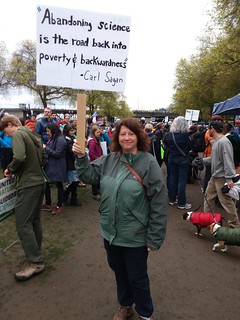
Representing Carl Sagan at the March for ScienceSome of my favorite quotes from the book:

For me, it is far better to grasp the Universe as it really is than to persist in delusion, however satisfying and reassuring.

Abandoning science is the road back into poverty and backwardness.

The values of science and the values of democracy are concordant, in many cases indistinguishable. Science and democracy began - in their civilized incarnations - in the same time and place, Greece in the seventh and sixth centuries B.C. . . . Science thrives on, indeed requires, the free exchange of ideas; its values are antithetical to secrecy. Science holds to no special vantage points or privileged positions. Both science and democracy encourage unconventional opinions and vigorous debate. Both demand adequate reason, coherent argument, rigorous standards of evidence and honesty.

The tenets of skepticism do not require an advanced degree to master, as most successful used car buyers demonstrate. The whole idea of a democratic application of skepticism is that everyone should have the essential tools to effectively and constructively evaluate claims to knowledge. All science asks is to employ the same levels of skepticism we use in buying a used car or in judging the quality of analgesics or beer from their television commercials.

The book talks about the origins of the Book of Deuteronomy - I had no idea it was magically "found" by Josiah, at the exact time he was wanting those exact same reforms in Judaism! How convenient...

I was also thrilled to learn of Robert Allen Baker. He's cited in the book as being a professor at the University of Kentucky and, of course, I had to look him up. He was a psychologist, professor of psychology emeritus of the University of Kentucky, skeptic, author, and investigator and debunker of ghosts, UFO abductions, lake monsters and other paranormal phenomena. He was born in 1921 in Blackford, in Webster County, Kentucky. He graduated from Hopkinsville High School in 1939. I'm always so thrilled to learn of a great Kentucky scientist or artist.

The book also gives a shout out to James Randi, whose legendary debunking stunts have never been matched - and that's a shame, because we need someone to undertake those very high-profile stunts now.

Carl Sagan died in 1996. I can only imagine what he would have made of the proliferation of anti-vaccine movements among well-off white people in the USA - and the harm these movements have caused to children. Thank goodness we still have Bill Nye and Neil deGrasse Tyson.

If you haven't read it, please do, at least the first seven chapters. Sagan talks way more than alien abductions than you might think necessary, but those myths were super widespread at the time he wrote this book, and the way he debunks them could be used for a whole host of other pseudoscience crap.

In addition, if you aren't following BionerdNess on Facebook, you need to be. It's a page by a friend of mine, a biologist and professor, and she focuses BionerNess on debunking a lot of science myths middle and upper class white people believe and promote. A perfect page for getting material to share on your own social networks - to continue the work of Sagan!

Also see this hilarious pro-vaccine video from Bill Nye (unfortunately, only available on Facebook).

Finally: I haven't written since February. I haven't written more because, quite frankly, I've been busy attending public meetings with elected officials and what not, trying to be more involved in our democracy, trying to stand against the growing nonsense and dangerous practices of the current presidential administration and state legislators across the USA. I hope you are just as busy.

Friday, February 3, 2017

Rebellions are built on hope

Record-setting numbers of people protesting all across the USA on January 31.

Phone lines of senators and congressional representatives jammed every day from people protesting executive orders.

Public meetings with senators and senators and congressional representatives jammed with people angry about their impending loss of health care coverage.

Mass, spontaneous protests at airports across the country.

Millions of dollars donated to the ACLU.

All in two weeks.

I won't say that I've had my faith in humanity restored. But I will say I have hope.